- The Kakapo use their short wings for balance and support rather than flapping.
- Their feathers are much softer than any other birds because they do not need to be strong and stiff enough to support flight.
- Even though they can’t fly they manage to get around.
- The Kakapo has strong legs which make them good hiking and climbing legs.
- On the ground they move around jog-like gait.
Friday, 14 March 2014
The Kakapo - Manuae

The Weka - Alisi
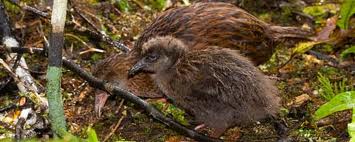
The Weka Bird.
- Weka mainly eat invertebrates and fruit. They occasionally eat chitons and other rocky invertebrates, lizards, rodents, food scraps, carrion and the eggs and young of other groundnesting bird.
- Weka populations are subject to large fluctuations. Populations increase during favourable conditions and decline abruptly when food becomes scarce. Moist islands and those with rich soils support the most stable populations.
- The decline and destabilisation of weka populations on mainland New Zealand, which has resulted in legal protection, has inhibited mahinga kai in modern times. Some iwi today welcome conservation projects that would potentially enable the restoration of harvesting while others believe that the time for harvest has gone. The only place where the legal harvest of Weka can occur is on the Chatham Islands and on some islands around Stewart Island.
- Weka have demonstrated that under good conditions and with high food availability, they can be very productive with year-round breeding recorded at several sites. However, pairs in other stable populations breed once a year or less.
- Weka mate for life where the populations are territorial, but this is not so when the need for defence is less likely.
The Kakapo - Alisi
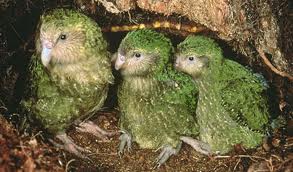
- The Kakapo is the world’s only flightless parrot and is also unusual in being nocturnal.
- The Kakapo is the world’s most heaviest parrot.
- The male Kakapo produces a strange “boom” call to attract potential mates, which can be heard up to 5 kilometres away.
- One of the world’s longest living birds. They can live up to an average of 90 years to a maximum of 120.
- A polygynous lek breeder.
- A non-flying bird.
- A parachutist from trees because it cannot fly.
- Critically endangered.
The Kiwi - Alisi
- Kiwis are flightless birds.
- Kiwis have a strong musky smell that is irresistible to dogs.
- Little spotted kiwi and North Island brown kiwi breed in pairs and only the male incubates the egg.
- The kiwi egg is six times as big as normal as a bird its size, almost exactly the size of eggs produced by the now-extinct bush moa.
- A female kiwi can lay up to 100 eggs in her lifetime.
- Kiwi have one of the largest egg-to-body weight ratios of any bird. A mature kiwi egg averages 20 percent of the female’s body weight (compared to 2 percent for an ostrich). In human terms this would mean a 50 kilogram woman delivering a 10 kilogram baby!
The Kakapo - Melenaite
The New Zealand kakapo
- One of the world's longest living birds. They can live up to an average of 90 years to a maximum of 120.
- The world's heaviest parrot
- The world's only nocturnal parrot
- A polygynous lek breeder
- A non-flying bird
- A parachutist from trees because it cannot fly
- Featured in the documentary from BBC 'Last Chance To See
- Critically endangered

The Kiwi - Manuae
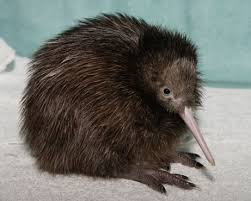
1.The kiwi is a curious bird it cannot fly.
2.The kiwi has loose hair like feathers.
3.The kiwi has strong legs and no tail.
4.They are most commonly forest dwellers.
5.They like making day time dens.
6.They also like making nest in burrows.
7.Kiwi are the only birds to have their nostrils at the end of the very long bill.
8.They use their bill to probe in the ground of the forest.
The Kiwi - Jahsiah
- The Kiwi is New Zealand’s national bird and considered an evolutionary oddity. It differs from all other bird species on earth.
- Kiwis are considered "non birdlike" and fill an ecological niche elsewhere occupied by mammals such as anteaters and hedgehogs.
- Unlike other birds, the Kiwi has a strong sense of smell.
- The Kiwi’s nostrils are situated at the end of its beak, unlike other birds that have their nostrils near the back of their beak. Its beak is equipped with pressure and vibration detectors enabling it to detect its prey deep underground.
- The Kiwi lays the biggest egg in proportion to its body-size. Even though the Kiwi is about the size of a chicken, its egg is six times the size of a chicken egg. The largest recorded Kiwi egg weighed 500 grams.

Subscribe to:
Posts (Atom)