- The Kiwi is a native bird to New Zealand.
- The Kiwi are nearly extinct
- The Kiwi cannot fly
- The Kiwi are rare to find
- The Kiwi are better off in captivity
Friday, 14 March 2014
The Kiwi - Moses


5 Facts About The Weka - Aarmione
The weka is a large, brown, flightless bird that has a famously feisty and curious personality.
Historically, the weka was a significant resource for some iwi, and the birds’ availability for sustainable harvest remains an important issue in weka conservation. Weka were also used by early European settlers, who gave it the name woodhen.
The weka’s best known call is a repetitive, loud ‘coo-et’ that is usually heard at dusk and in the early evening.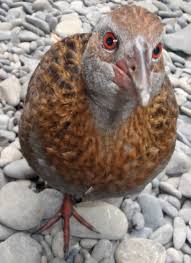 It is presented as a duet, with the male giving the lower and slower part. Weka are usually heard, not seen, although some birds, usually those living near farms or tramping huts, get a reputation for pilfering crops, food and other small objects. They will take the objects to the nearest cover to investigate them. For this reason it is best not to chase weka but to simply watch where the weka goes and retrieve the objects a little later.
Here is a Picture of a Weka:
Here is a link for more information:
http://www.kcc.org.nz/weka
Historically, the weka was a significant resource for some iwi, and the birds’ availability for sustainable harvest remains an important issue in weka conservation. Weka were also used by early European settlers, who gave it the name woodhen.
The weka’s best known call is a repetitive, loud ‘coo-et’ that is usually heard at dusk and in the early evening.
It is presented as a duet, with the male giving the lower and slower part. Weka are usually heard, not seen, although some birds, usually those living near farms or tramping huts, get a reputation for pilfering crops, food and other small objects. They will take the objects to the nearest cover to investigate them. For this reason it is best not to chase weka but to simply watch where the weka goes and retrieve the objects a little later.Here is a Picture of a Weka:
Here is a link for more information:
http://www.kcc.org.nz/weka
Thursday, 13 March 2014
The New Zealand Kakapo, Melenaite
The New Zealand Kakapo
- One of the world's longest living birds. They can live up to an average of 90 years to a maximum of 120.
- The world's heaviest parrot
- The world's only nocturnal parrot
- A polygynous lek breeder
- A non-flying bird
- A parachutist from trees because it cannot fly
- Featured in the documentary from BBC 'Last Chance To See
- Critically endangered

Wednesday, 5 March 2014
Alan Duff's Visit to Glenbrae
Alan Duff’s Visit to Glenbrae
On Tuesday, the 25 of February 2014, a very famous person came to visit us at Glenbrae School. His Name was Alan Duff.
Alan came to our school to talk to us about how important having books in houses are. He introduced himself to us, and he told us that he was the reason why we get free Duffy books every term.
After he had told us a bit about himself, it was question time. After that, we got a few photos of him, and some very lucky people, including me got his autograph.
When we had finished taking photos, he went to a different class.
I would like to thank Alan Duff for coming to school to talk to us.
The NZ Moa Bird,
The New Zealand Moa Bird
The New Zealand Moa Bird
- Moas were unique among flightless birds, having lost any trace that they once had wings.
- Not even tiny wing bones or a wishbone were left.
- As well as bones, mummified moas and well preserved feathers have been found.
- Fragments have been found at many sites, including prehistoric Maori settlements, where the eggs had been cooked and eaten.
- Related to the ostriches and emus, there were 11 species of moa, from the turkey-sized Euryapteryx curtus to the huge Dinornis giganteus.

Monday, 3 March 2014
Digital Technology, Manuae
Last Friday we went to Technology and we were learning about Healthy Food choices.We had to do a healthy vision board and an unhealthy vision board.The first vision board I am going to show you is a healthy breakfast.

Friday, 28 February 2014
Bio Poem, Melenaite
Bio Poems
Melenaite
Helpful,friendly and gamey
Lover of drawing ,playing,singing and eating Sushi
Who feels excited when going somewhere fun
Who wonders if ghosts and mermaids are real
Who fears spiders and ghosts
Who would like a limo
Who is able to run and swim
Who dreams of being a teacher.

By Melenaite
Subscribe to:
Posts (Atom)